
Prepaid vs. Postpaid: Don't Pay for a Plan You'll Never Use Up
Smart, Globe, and DITO all want you locked into a monthly bill. Here's how to tell whether that bill is actually cheaper than your current load habit — or just a subscription you forgot to cancel.
Updated on 08/10/2026 · 9 min read
Quick answer
Prepaid is cheaper for light and irregular users because you pay only for the promos you load; postpaid is better value when you consistently use large data allowances every month or want a bundled handset. Compare your actual monthly data usage against the postpaid plan's included allowance — most people who switch to postpaid never use the full bundle. Postpaid also involves a contract, credit checks, and lock-in, while prepaid has none.
Key takeaways
- Postpaid only wins when you reliably consume most of the included data and calls.
- Postpaid plans usually have 24-month lock-in and pre-termination charges.
- Prepaid promos let you match spending to actual usage month by month.
- Handset bundles spread the phone's cost into the monthly bill, often at an effective premium.
- Both are subject to SIM registration under the SIM Registration Act.
Postpaid wins if your monthly spend on load already averages more than what a comparable plan costs, and you want one predictable bill with unli calls, texts, and a bigger data pool. It's a bad deal if your usage swings a lot month to month, because you're billed the same amount whether you use 2GB or 20GB.
Prepaid wins on flexibility — no lock-in, no bill shock, easy to pause. Its hidden cost is that ad-hoc promos, bought one at a time, often work out more expensive per gigabyte than a postpaid plan's flat rate. Neither option is "better" — only better matched to how you actually use your phone.
Why Telcos Want You on Postpaid in the First Place
Telcos aren't doing anything Netflix, your gym, or your streaming bundle haven't already figured out: once a service auto-debits from your bank account or card every month, the question "do I actually still need this?" quietly stops getting asked. The charge just happens — whether you used the service heavily or barely opened the app that month.
Prepaid works against that by accident. Every reload is a small, deliberate decision, which means it's also a natural checkpoint: did last month's load actually get used, or did it expire half-full? Postpaid removes that checkpoint entirely. That's not a reason to avoid it — a genuinely heavy user still comes out ahead. It's just a reason to be the one still asking the question your bank account no longer will.
The Core Difference: Who Fronts the Money
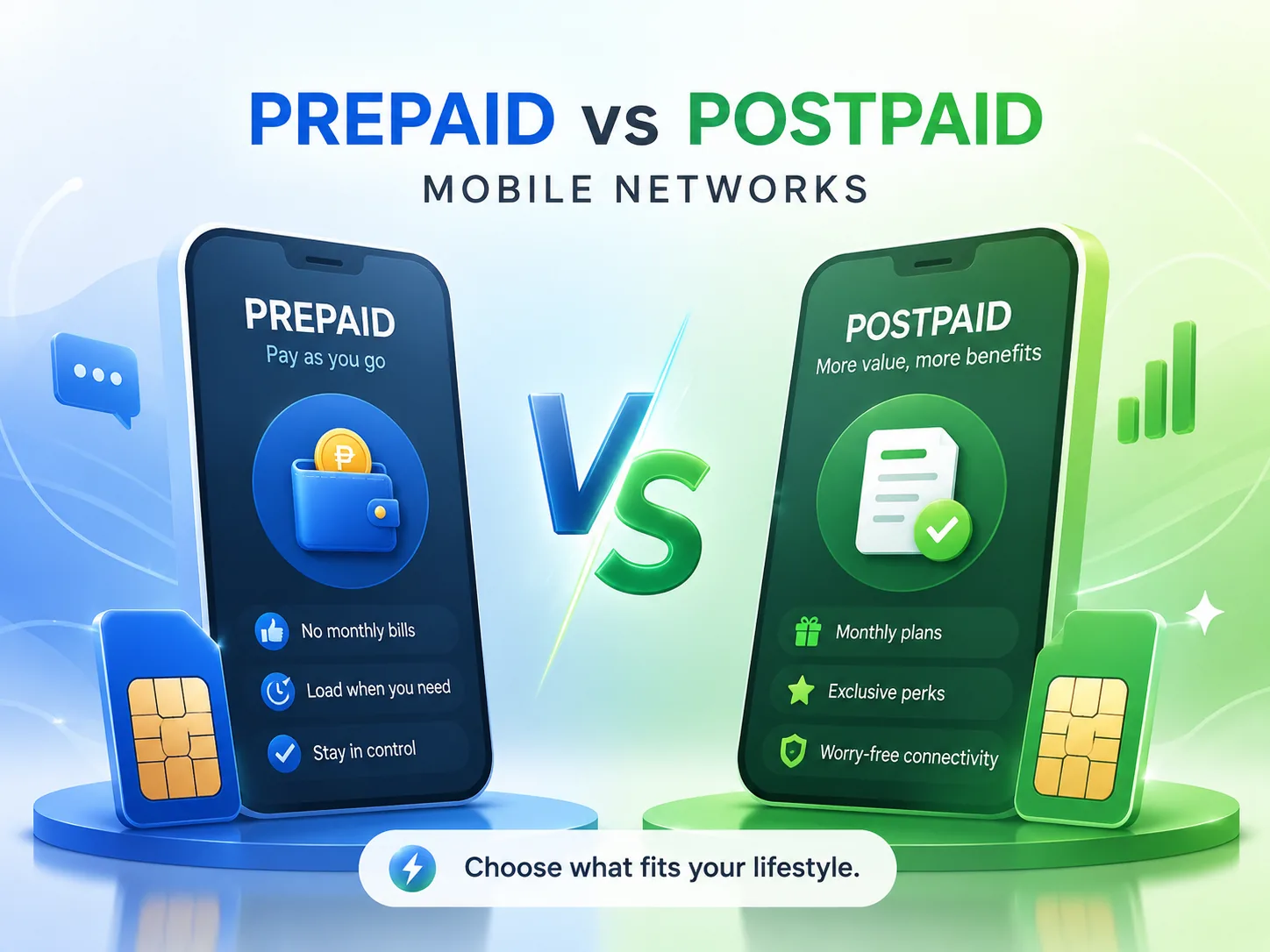
Prepaid and postpaid run on the same towers from the same telco. The only real difference is the billing relationship: with prepaid, you pay first and consume what you bought. With postpaid, you consume first and the telco bills you afterward — which is why it requires a credit check, a signed contract, and (for most plans) a lock-in period.
- + One flat monthly bill, easier to budget for exact amount
- + Unli calls and texts to all networks as standard on almost every current plan
- + Bigger data allocations per peso than most one-off prepaid promos
- + Access to free or subsidized handsets on installment
- + Builds a payment record with the telco, useful for future credit applications
- − Most plans carry a lock-in period (commonly 6–24 months); breaking it early means a fee
- − Requires a credit check and documents; approval isn't guaranteed
- − You pay the full plan cost even in a month you barely use your phone
- − Overages, add-ons, and surcharges can quietly inflate the bill
- + Zero commitment — stop reloading anytime, no cancellation fee
- + No credit check, no documents, no risk of a delinquent account
- + Spend scales exactly with how much you actually use
- + Easy to run two SIMs (dual-SIM) and mix networks for coverage
- + Impossible to rack up unexpected debt from your phone line
- − Promos expire; unused data, calls, or texts are usually forfeited
- − Per-gigabyte cost is often higher than an equivalent postpaid plan
- − Service cuts out the moment your promo runs out or load hits zero
- − Constant reloading is easy to forget, easy to overspend on impulse top-ups
Network by Network: Smart, Globe, and DITO
Only three real networks exist in the Philippines — Smart, Globe, and DITO own the towers. TM is just Globe's budget sub-brand, not a network of its own.
Postpaid
- Plans+ lineup, unli all-net calls & texts
- Optional Unli App add-ons (social, streaming, gaming)
- ~12–24 month lock-in
Prepaid
- GIGA promos via the GigaLife app
- Mix-and-match data, validity, app packs
- Magic Data doesn't expire
Best signal outside Metro Manila.
Postpaid
- GPlan / GPlan PLUS, unli all-net + landline calls
- Some entry tiers have no lock-up
Prepaid
- Go, GoSURF, GoUNLI promos via GlobeOne app or GCash
- GoRENEW auto-renews promos for you
Strongest in NCR; deep GCash integration.
Same Globe network, no postpaid option, cheaper promos than Globe's main brand.
Postpaid
- FLEXPlans, cheapest SIM-only postpaid around
- Lock-in varies by promo — confirm at signup
Prepaid
- Lowest price-per-GB where signal is strong
- Short validity options for light users
Strong 5G in NCR, Davao, CDO — weaker elsewhere. Test signal before switching.
Why People Actually Pick One Over the Other
- They're done budgeting for load. One number every month is easier to plan around than reload receipts scattered across the week.
- They want a subsidized phone. A device bundled into the plan spreads the cost over 24 months instead of one lump sum.
- They talk and text heavily. Unli all-net calls and landline access as standard inclusions beat paying per combo promo.
- They're building a credit footprint. A clean postpaid payment history is a small but real data point for future loan or credit card applications.
- They hate running out mid-conversation. No risk of a call dropping because load ran out.
- Their income isn't fixed. Freelancers, gig workers, and commission-based earners can't guarantee the same bill lands the same way every month.
- They don't want a paper trail. No contract, no credit check, no risk of a collections call over a missed bill.
- Their usage is genuinely unpredictable. Some months are data-heavy, others barely touch the phone — prepaid lets spend follow use.
- They run a backup or secondary SIM. A second, low-cost prepaid line for a different network's coverage costs nothing when it's idle.
- They're not ready to commit. New to a network, testing signal in a new address, or simply don't want a 12–24 month tie-in.
Do the Math: Is the "Free" Phone Actually Free?
A subsidized device is one of the top reasons people choose postpaid — but the phone isn't free, it's financed. Its cost is folded into a higher monthly fee for the length of your contract. Sometimes that works out cheaper than buying outright. Often it doesn't. Plug in real numbers below to see which side of the line your specific plan actually falls on.
Uses your own numbers — check the device-bundled plan's fee and the SIM-only equivalent (same data/calls/texts, no device) directly on the telco's site before comparing.
Don't Pay for a Service You're Not Using
This is the checkpoint your bank account won't run for you. The single most common way people overspend on mobile plans isn't a bad rate — it's paying every month for data, minutes, or perks they never touch. Run this quick check before choosing postpaid over prepaid, or before upgrading to a bigger plan than you need.
Add up your last three months of reloads. If it's consistently below a postpaid plan's monthly fee, postpaid isn't saving you anything — it's adding a fixed cost you didn't have.
If you regularly finish a promo with data, calls, or texts unused, a bigger plan (prepaid or postpaid) just means more waste, not more value.
If there's any chance you'll move, switch jobs, or want to change networks in the next year, a 12–24 month postpaid contract is a liability, not a convenience.
Bundled streaming subscriptions and app-specific unli data sound generous, but only count toward value if they replace something you'd already pay for separately.
Both prepaid (GoRENEW, auto-load) and postpaid billing can quietly renew add-ons you no longer need. Review your active subscriptions every few months.
Which One Fits Your Situation
| If you are… | The reasoning | Lean toward |
|---|---|---|
| A light user who mostly texts and uses Wi-Fi at home/work | Your monthly usage is small and irregular — a flat postpaid bill would mostly go unused. | Prepaid |
| A heavy streamer or remote worker on video calls daily | Your data need is large and consistent enough that a flat-rate plan beats stacking promos. | Postpaid |
| A freelancer or gig worker with variable monthly income | A fixed monthly obligation is riskier when your income isn't fixed. | Prepaid |
| Someone who wants a new phone without the upfront cost | Postpaid spreads the cost over the contract term with no separate interest charge — but run the calculator in Section 5 first, since the bundled monthly fee alone can still end up pricier than buying outright. | Postpaid* |
| New to an area and unsure which network has signal there | Testing coverage with a prepaid SIM avoids being locked into a contract on a network that doesn't reach your address. | Prepaid |
| Running a small business needing a reliable, always-on line | Losing signal because load ran out mid-transaction is a real cost; a predictable bill is worth it. | Postpaid |
| Keeping a backup or secondary SIM for a different network | A second line only needs to cost something when it's actually used. | Prepaid |
*Assuming you'd have financed the phone another way anyway. If you'd have paid cash outright, check Section 5 before assuming the bundle is the cheaper route.
Switching Sides Without Losing Your Number
Under the Mobile Number Portability Act (RA 11202), you can move between prepaid and postpaid, or even between networks, while keeping your existing 11-digit number. A few things matter if you're planning the switch:
Make sure your prepaid SIM is fully registered under your legal identity per the SIM Registration Act — the name must match your postpaid application documents.
Keep the prepaid line active. Don't cancel it yourself — an inactive, suspended, or expired number can't be ported.
Apply for postpaid through the network's app, store, or website, and request number retention during the application.
Expect a short transition window while the port completes. Avoid urgent calls or transactions on that number during the switch.
You Don't Need a Physical SIM Anymore
All three networks now support eSIM, so the postpaid-vs-prepaid decision doesn't have to involve a physical card, a store visit, or a delivery wait at all — on Smart, Globe, and DITO alike, for both prepaid and postpaid lines.
Activate straight from the network's app in minutes — no SIM tray, no store queue, no waiting for a courier.
Still covered by the SIM Registration Act — you'll verify your identity during setup, same as a physical SIM.
Handy for testing a network's signal in a new area, or running a second line, without committing to a physical card.
Not every device supports eSIM, and not every plan offers it yet — check compatibility before you drop the idea of a physical SIM entirely.
Frequently Asked Questions
Is postpaid better than prepaid in the Philippines?+
What documents do I need to apply for a postpaid plan?+
Can I cancel a postpaid plan before the lock-in period ends?+
What happens if I miss a postpaid bill payment?+
Is TM the same company as Globe?+
Can I have both a prepaid and postpaid SIM at the same time?+
Do prepaid and postpaid get the same network speed?+
It's the one that matches how you actually use your phone. Track three months of your real usage before switching. If you can't remember the last time you ran out of data, you're probably already paying for more than you need.
Plan names, prices, data allocations, and lock-in terms change frequently and vary by promo period, region, and individual offer eligibility. Figures here are illustrative of current market structure as of 2026 — always confirm exact pricing and terms directly with Smart, Globe, or DITO (or Globe's TM sub-brand) before signing up.
Read next
Best Internet Plans PH 2026: Price & Speed
Phone plan sorted? Compare every major home internet provider by real price per Mbps.
Read the guide