
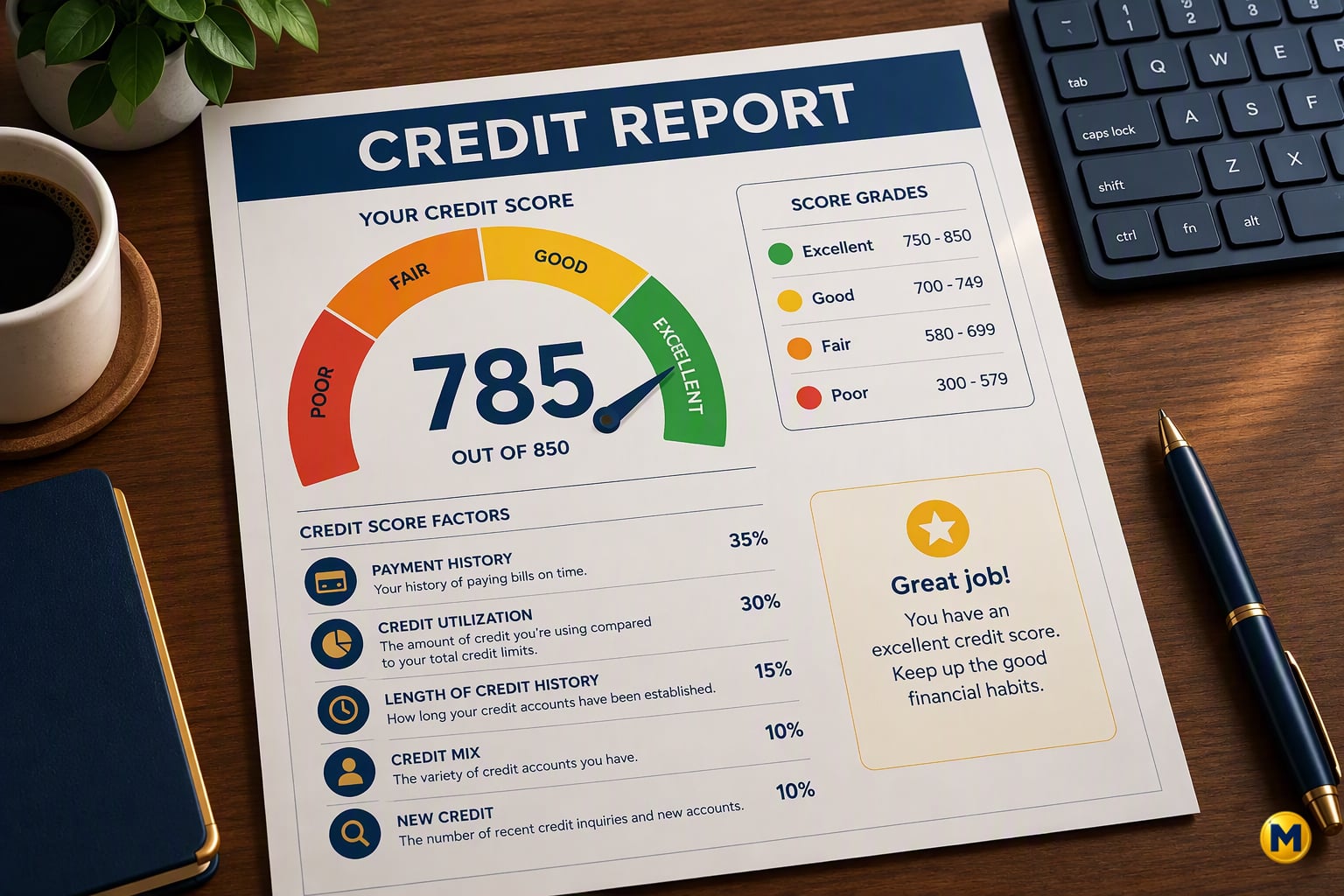
What is it, simply?
A credit score is a three-digit number — ranging from 300 to 850 — that tells banks and lenders how reliably you repay borrowed money. The higher the number, the better. In the Philippines, your score is compiled by the Credit Information Corporation (CIC) — the government's public credit registry under Republic Act No. 9510 — from data submitted by your banks, Pag-IBIG, SSS, cooperatives, and financing companies.
Three accredited credit bureaus then access this data to calculate your score and issue your report:
Personal info (name, address, IDs) · Credit history (loans, cards, payment track record) · Outstanding balances & overdue amounts · Hard inquiries from lenders. It does not show your salary or cash purchases.
Where to get your report — the 4 official methods
The CIC supports four official channels.
| Channel | Fee | Wait Time |
|---|---|---|
| Lista PH App (CIBI) | ₱299 | Instant |
| Lista PH App (TransUnion) | ₱610 | Instant |
| CIBIApp Web Portal | ₱235 | Same day |
| TransUnion (Email) | ₱200 | 7–10 days |
| CRIF Philippines (Email) | Varies | Varies |
| CIC Direct (via your bank) | Free (annual) | Varies |
The CIC provides one free credit report per year through your bank (if it is a CIC Accessing Entity) or during official promo periods. Outside this, expect to pay ₱199–₱610. Checking your own report is a soft inquiry — it does not affect your score.
Lista PH App — CIC Official
★ Easiest MethodThe CIC's official consumer app. Everything is done on your phone — including identity verification via liveness check (face scan). You can request both a CIBI report and a TransUnion report from the same app.
- 1Download Lista PH from the Google Play Store or App Store. Sign up with your mobile number.
- 2Tap Request Now on the Credit Score & Report dashboard. Enter your personal details exactly as they appear on your valid government ID.
- 3Upload your valid ID photo and complete the liveness check (face scan) for identity verification.
- 4Choose your report type — CIBI (₱299) or TransUnion (₱610) — and pay via GCash, credit card, or online banking.
- 5Download your password-protected PDF. Open it using your date of birth in YYYYMMDD format (e.g. July 18, 1983 → 19830718).
CIBIApp Web Portal
The desktop/browser version of CIBI's consumer portal. Requires a video call with a live CIBI verifier for KYC — set aside 15–20 minutes.
- 1Visit cibiapp.cibi.com.ph and create an account with your email address.
- 2Fill out the application form and schedule a video call for identity verification.
- 3Pay ₱235 online. Your credit report with score is emailed after the video verification is complete.
TransUnion Philippines — Email
The most affordable way to get a TransUnion-specific report. Requires two valid government IDs and a selfie. Allow 7–10 business days.
- 1Download the application form from transunion.ph. Fill it out completely.
- 2Scan two valid IDs and take selfies holding each ID. Zip all files together.
- 3Email the zip to TransUnion Philippines and pay the ₱200 fee as instructed. Receive your report within 7–10 business days.
Via Your Bank — CIC D2C Program
Under CIC Circular No. 03 (2023), authorized financial institutions — CIC Accessing Entities — can now issue your credit report directly to you. If your bank is an Accessing Entity, you may be able to request your report as part of a loan or card application.
What the number actually means
Credit scores in the Philippines range from 300 to 850. Here is how lenders generally interpret your number:
The five factors that build or break your score
Payment History — the biggest factor
Every on-time payment is a positive mark. Every missed, late, or defaulted payment is a negative one. Even a single 30-day late payment can drop your score significantly. Set auto-debit on all loans and credit cards.
Credit Utilization Ratio
How much of your available credit are you using? Keep this below 30%. If your card limit is ₱50,000, try not to carry a running balance above ₱15,000.
Length of Credit History
Older accounts improve your score by showing a longer track record. Keep your oldest credit card open — even if you rarely use it — to preserve the account age.
Types of Credit Used
A mix of credit types — a card, a personal loan, a Pag-IBIG record — shows you can manage different obligations. Don't open accounts purely for variety, though.
Recent Credit Inquiries
Every new loan or card application triggers a hard inquiry. Multiple applications in a short period signal financial stress and can temporarily lower your score. Space applications at least 6 months apart.
Many Filipinos don't realize that Maya (via GScore) and GCash (via Fuse Lending) — while running their own internal credit scoring — are now active submitting entities to the CIC. This means every loan you take through these apps is reported to TransUnion and CIBI, just like a bank loan.
The risk is asymmetric: a ₱5,000 app loan default can appear as a derogatory mark on your CIC credit report and block approval for a ₱5,000,000 home loan years later. Lenders run full CIC checks for mortgages and car loans — and a single unresolved app loan default is enough to trigger a rejection or a significantly higher interest rate.
What to do: Treat every Maya, GCash, Billease, or app-based loan with the same seriousness as a bank loan. Pay on time. If you have a past-due app loan, settle it immediately and request a clearance letter — then monitor your CIC report to confirm the status is updated.
How to improve your score
Your credit score is not fixed — it moves every time new data is submitted to the CIC. Here are the most effective actions you can take, ranked by impact.
Pay every bill on time — without exception
This is the single highest-impact action. Set up auto-debit for all loans and credit cards so you never miss a due date. Even one 30-day late payment can take months to recover from.
Bring your credit card utilization below 30%
If your total credit limit across all cards is ₱100,000, keep your running balance below ₱30,000. Pay down balances before your statement closing date — not just the due date — for maximum impact.
Settle any past-due app loans immediately
Maya, GCash, and Billease defaults show up on your CIC report just like bank loan defaults. If you have an overdue app loan, settle it now, get a clearance letter, and monitor your report to confirm the status is updated.
Keep your oldest credit card open
Closing an old account shortens your credit history and can lower your score. Even if you barely use an old card, keep it active with a small recurring charge — like a Netflix subscription — and pay it in full monthly.
Space out new credit applications
Every loan or card application triggers a hard inquiry. Apply for no more than one new credit product every 6 months. Shotgunning applications in a short window signals financial desperation to lenders.
Build from zero with a secured credit card or government loan
If you have no CIC file, start with a secured credit card (your deposit is the collateral) or a small SSS/Pag-IBIG loan. Pay it back perfectly every month. Your file begins building within the first billing cycle.
Realistic improvement timeline: Score improvement is not instant — the CIC system updates as lenders submit new data, typically monthly.
| 1 – 3 months | On-time payments start registering. Small positive movement. |
| 6 months | Noticeable score improvement, especially if utilization is low. |
| 12 months | Significant improvement possible. Enough to qualify for most bank products. |
How to dispute errors on your report
Errors are more common than most people realize — a paid-off loan still showing as active, an account that isn't yours, or an incorrect balance. Under RA 9510, you have the right to correct inaccurate information. Filing a dispute with the CIC is completely free.
Late payments, defaults, and adverse records typically remain on your CIC report for seven years. You cannot remove accurate negatives — but you can dispute and correct inaccurate entries, and offset old negatives with a strong recent payment history.
- 1
Get your latest credit report
Pull a fresh report via Lista PH or CIBIApp. Review every account, balance, and inquiry carefully. Screenshot anything that looks incorrect.
- 2
Gather your evidence
Collect receipts, bank statements, clearance letters, or screenshots proving the entry is wrong. The burden of proof is on you to show the discrepancy.
- 3
File via the CIC Online Dispute Resolution Process (ODRP)
Go to creditinfo.gov.ph, click "Online Dispute," and submit your Data Correction Form (DCF) with supporting documents. No filing fee required.
- 4
Wait for verification
The CIC coordinates with your bank or lender to investigate. This can take several weeks. You'll receive an email update on the outcome.
- 5
Re-pull your report after resolution
Once the dispute is resolved, request a fresh report to confirm the correction is reflected before applying for any new credit.
⚠️ Scam Warning — Fake “Free Credit Score” Sites
Websites and social media pages claiming to offer free or instant credit score checks are widespread in 2026. Many are phishing traps designed to harvest your personal information — full name, ID number, date of birth, and mobile number — which can then be used for identity theft or fraudulent loan applications in your name.
The only legitimate consumer channels are: Lista PH, CIBI, TransUnion, and CRIF. When in doubt, always go directly to creditinfo.gov.ph.
Before you check — read this.
- →Check your report at least once a year, and 3–6 months before applying for a major loan (home, car, business).
- →Checking your own report is a soft inquiry — zero impact on your score. Only lender-initiated checks (hard inquiries) affect it.
- →Your Lista PH PDF is password-protected with your birthday in YYYYMMDD format — save this somewhere safe.
- →If you have no credit history, start with a secured credit card or a small SSS/Pag-IBIG loan, then pay it back on time. Your file builds within 6–12 months.
- →Dispute errors immediately — unresolved errors follow you into every future credit application.
- →Space out new card or loan applications by at least 6 months to avoid multiple hard inquiries dragging your score down at once.